Marriage Certificate from Sweden: Which Paper Is the Real Document and Which Will Be Turned Away at the Counter
The municipal keepsake, SKV 7887, a personbevis “Adress” or Registerutdrag – vigsel (SKV 7693)? Real photos show which Swedish paper Moldova and Romania accept.
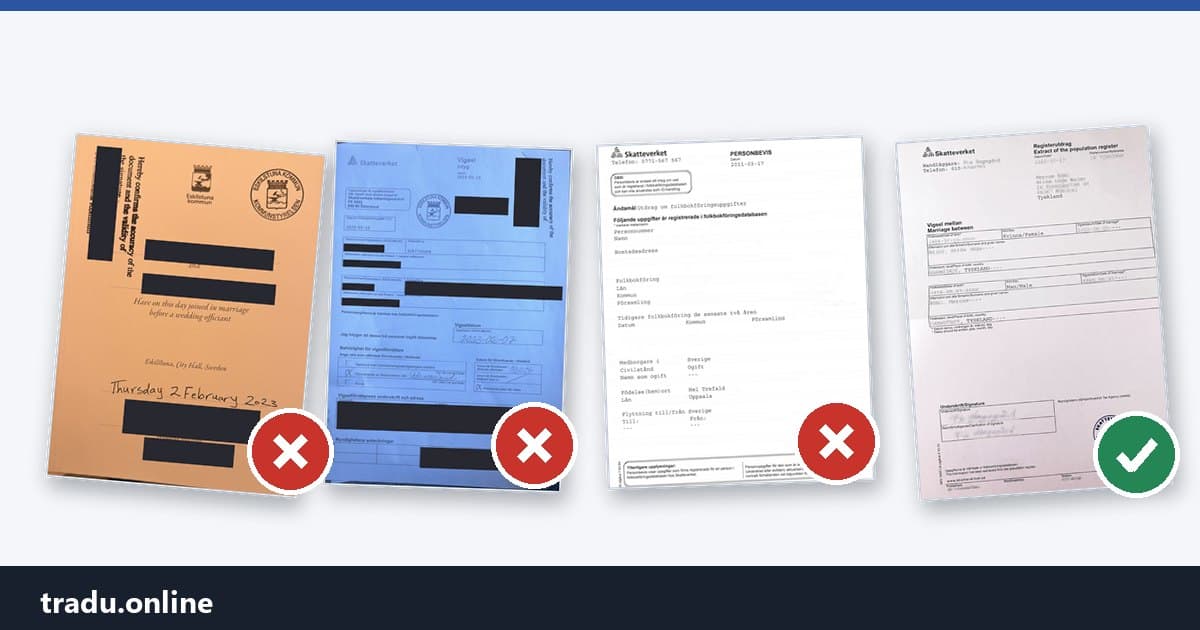
Translation is the last step, not the first. Before it, you need to know whether the paper in your hand really is the document the authority is asking for. We start from a real case from Sweden.
The real case: two “marriage” papers from Sweden
A client sent us two documents he had brought from Sweden, convinced that he had his marriage certificate and that all it still needed was a translation and an apostille. The personal data is covered.
The decorative certificate from the ceremony
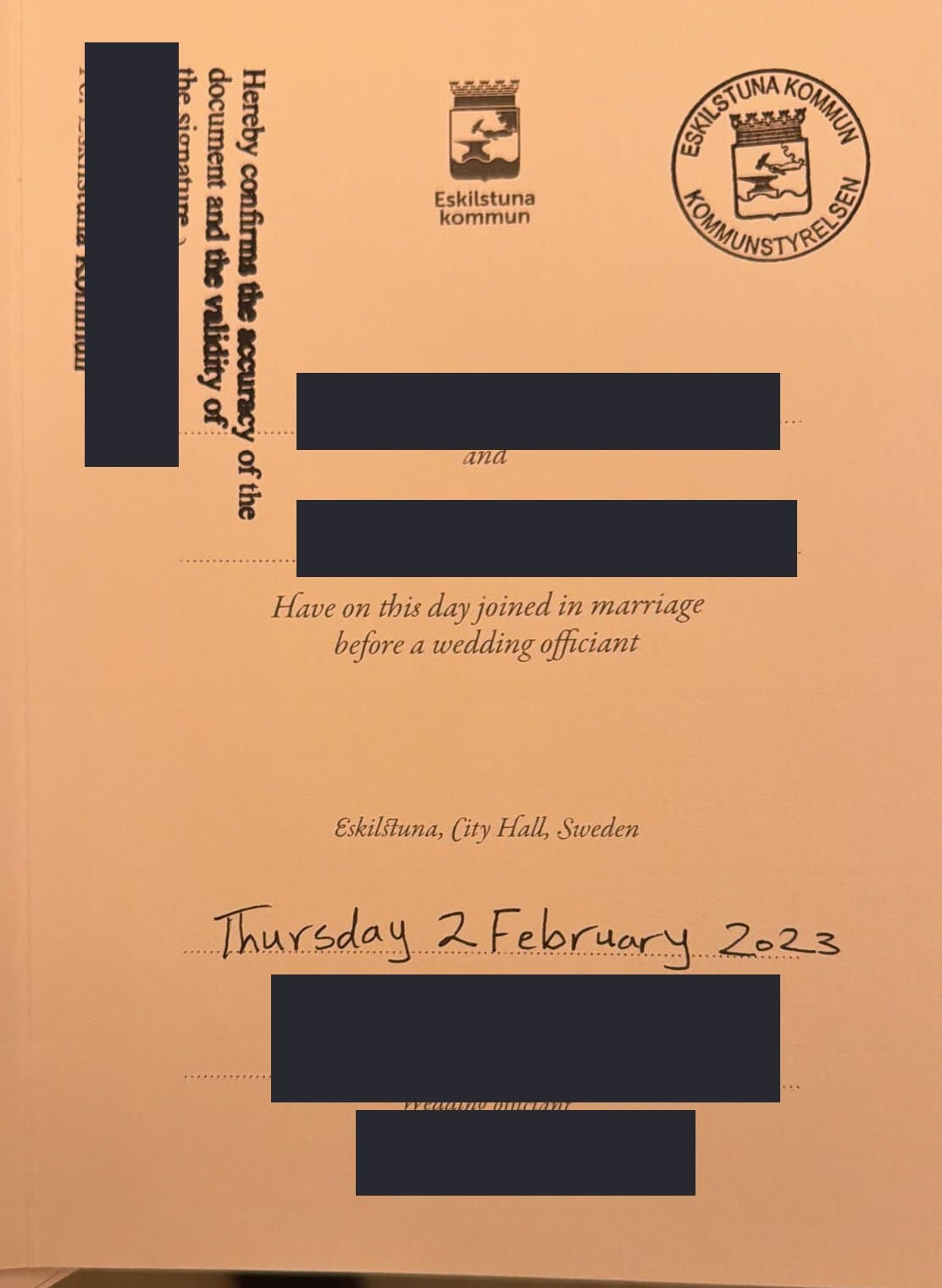
- What it looks like: an official certificate — the town's coat of arms, the Kommunstyrelsen stamp, the officiant's signature, even a note in English saying the document is authentic.
- What it is: a keepsake given to the couple on their wedding day. The municipality does not keep the marriage register — in Sweden that is done by Skatteverket (the Swedish Tax Agency).
- The trap: the wording “Hereby confirms the accuracy…” confirms the signature, not the registration of the marriage. It is not an apostille.
The marriage officiant's form (SKV 7887)
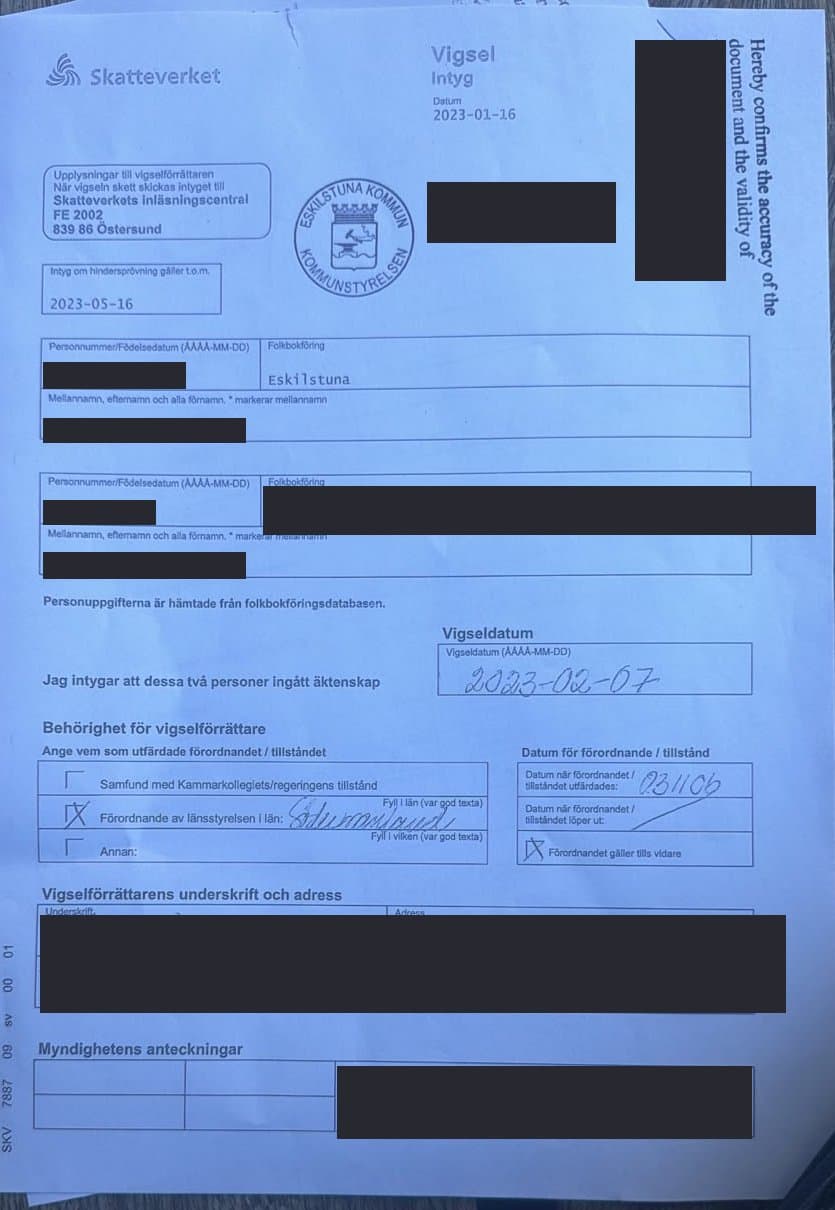
- What it looks like: a state document — the Skatteverket letterhead, the couple's personal identity numbers, the date of the marriage.
- What it is: the form issued before the wedding, once the impediments to marriage have been examined (hindersprövning, dated 16.01.2023, valid until 16.05.2023). The officiant fills it in by hand and sends it to Skatteverket, and only then does Skatteverket register the marriage.
- The trap: the printed details come from the register, so the form looks like an extract. But it does not confirm that the registration ever took place.
The client searches for “personbevis” online — and finds yet more papers
Sweden has no “marriage certificate” of the kind issued in Moldova or Romania. What it has are extracts from the population register. The catch is that dozens of variants circulate under the same Skatteverket letterhead, and nearly all the samples you find online are the wrong ones.
The general extract, but old and “unmarried” (SKV 7780)
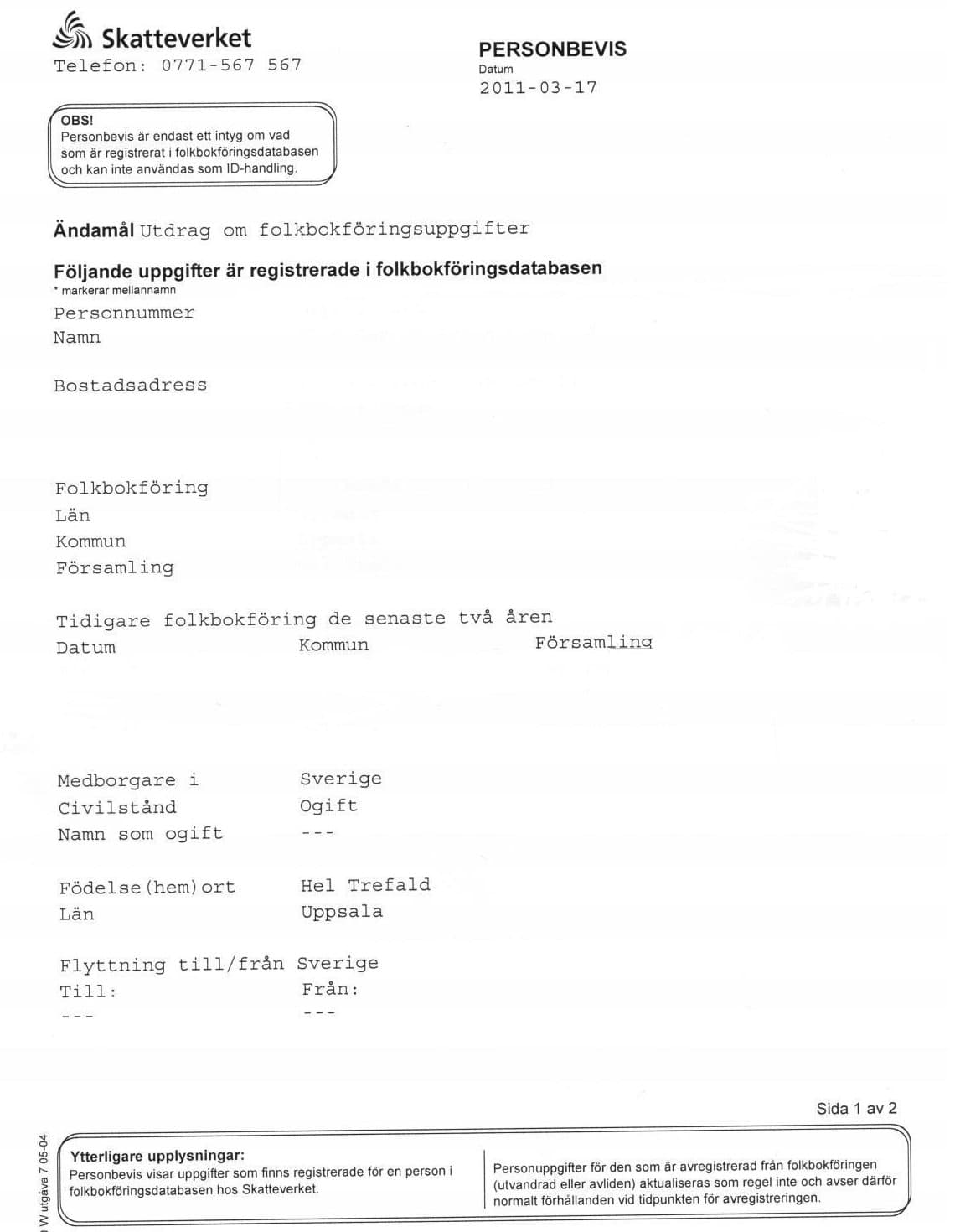
- What it is: the full extract from the population register — address, citizenship, civil status, place of birth.
- Why it won't work: the civil status is Ogift — unmarried. It has no section about a spouse. It dates from 2011, and page 2 — the one with the stamp and the signature — is missing.
- The lesson: it has to be ordered fresh, with “Civilstånd: Gift”, with the spouse's details and with a stamp.
The sample on the Skatteverket website
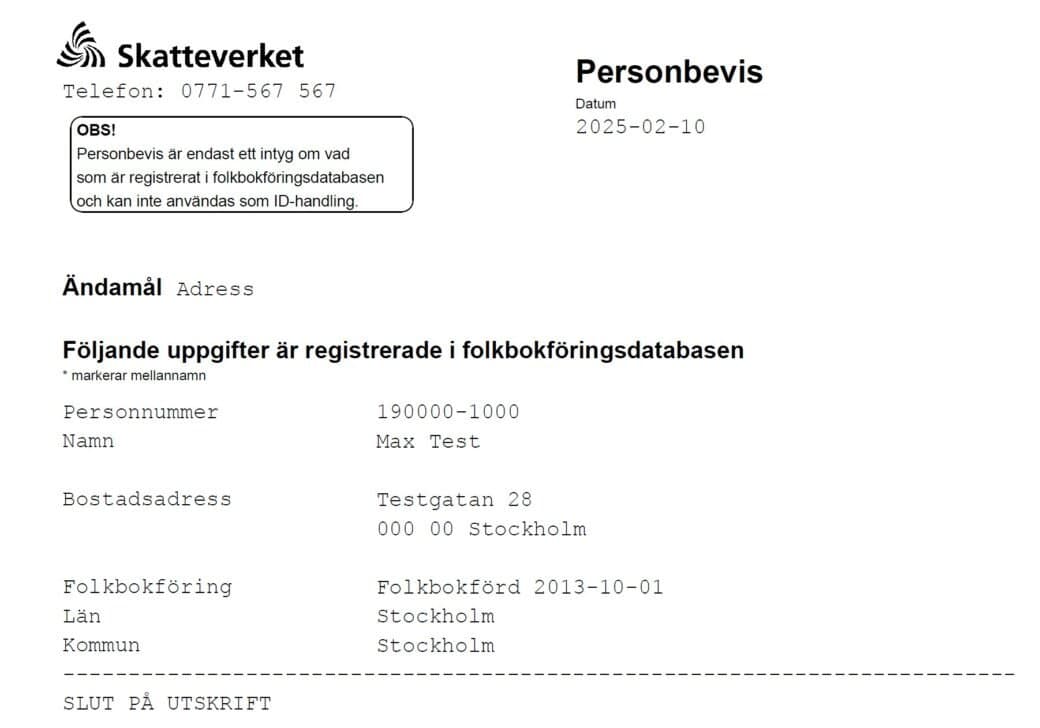
- What it is: a demonstration sample — “Max Test”, “Testgatan 28”, the non-existent personal identity number 190000-1000.
- Why it won't work: the purpose is “Adress” — it shows only the registered address. There is no civil status field.
The same type, printed from the online account
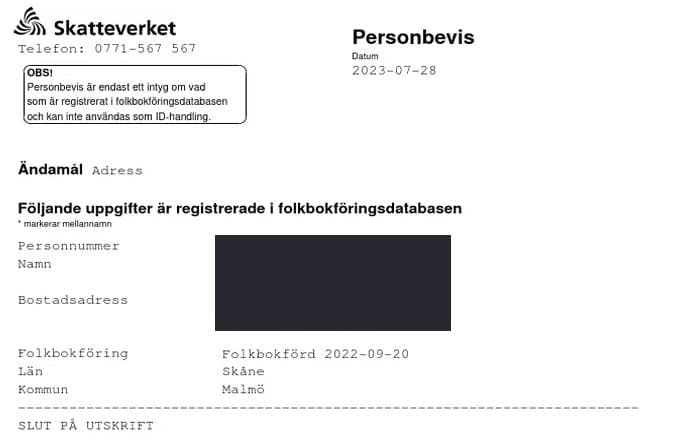
- What it is: a real personbevis, but downloaded from the Skatteverket e-service and printed at home.
- Why it won't work: it shows only the address. And the line SLUT PÅ UTSKRIFT (“end of listing”) gives it away as a self-printed copy, with no stamp and no signature — the notary will not apostille it.
A “Registerutdrag” — but a tax one
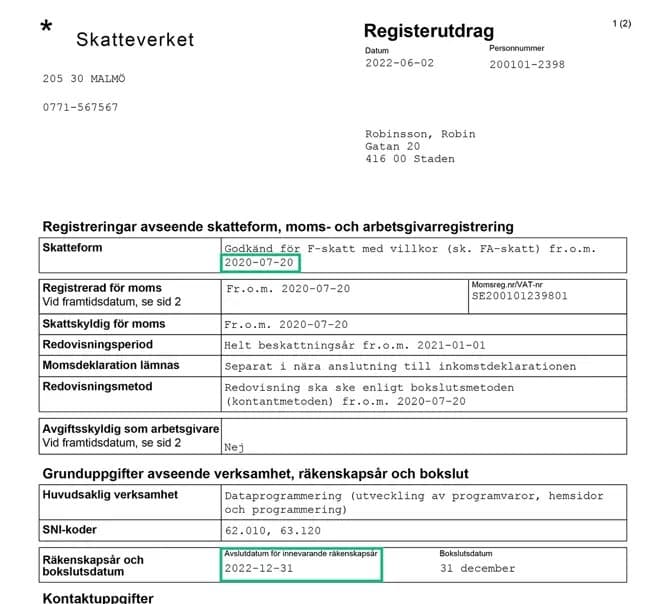
- What it is: an extract from a sole trader's tax register entry (sample: “Robinsson, Robin, Gatan 20, Staden”) — F-skatt status, VAT number, business activity, financial year.
- The trap: the word Registerutdrag simply means “extract from the register”. What matters is which register. This one has nothing to do with civil status.
The extract about the marriage (SKV 7693) — this is the document
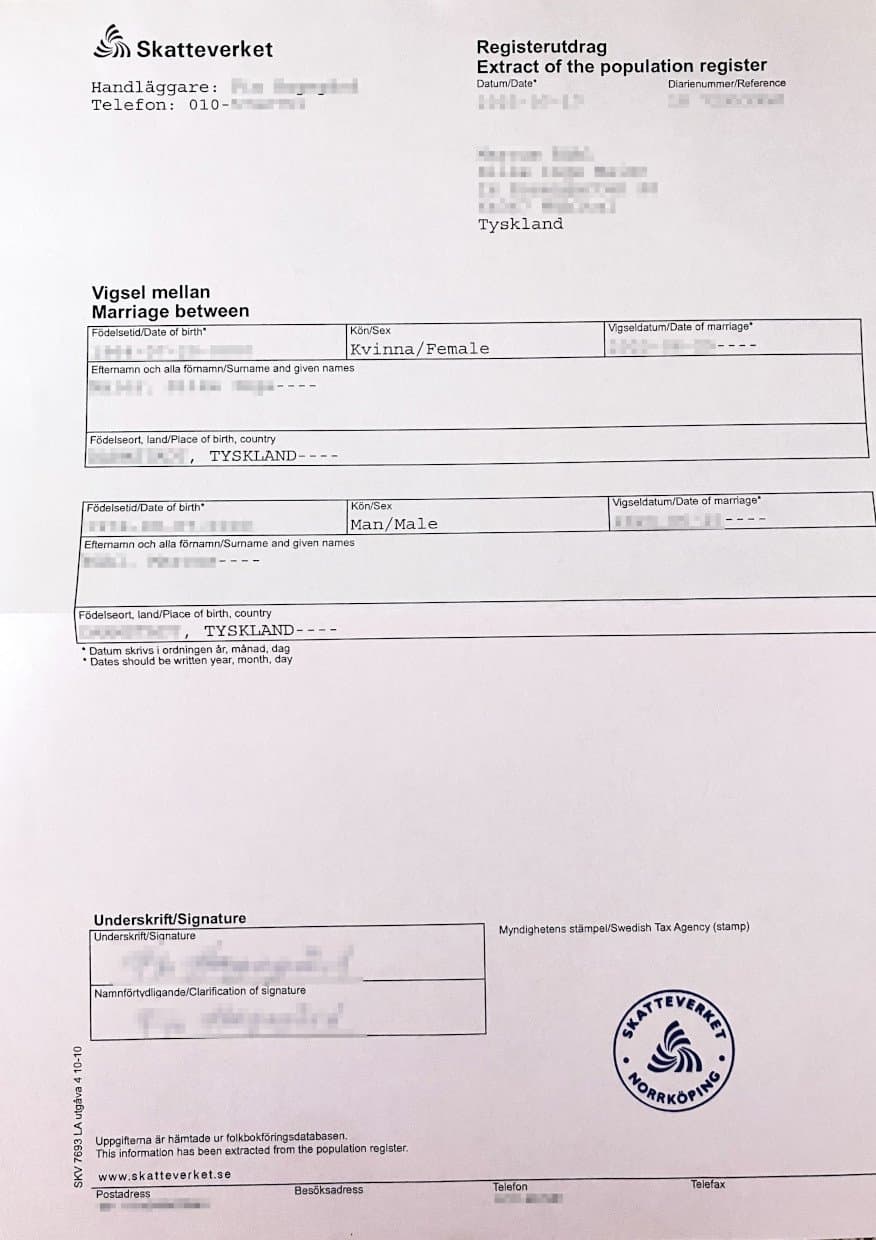
- How to recognise it: the bilingual title “Registerutdrag / Extract of the population register”, the section “Vigsel mellan / Marriage between”, one block for each spouse with the date of the marriage, the signature of a named official, the round Skatteverket stamp and a case number (Diarienummer).
- What comes next: an apostille from a notarius publicus in Sweden, then a certified translation into Romanian.
Sweden in brief
| Document | What it proves | Good for the file? |
|---|---|---|
| The municipality's decorative certificate | Nothing in law | No |
| SKV 7887 Vigselintyg | The request to register the marriage | No |
| SKV 7780, purpose “Adress” | Only the registered address | No |
| SKV 7780, purpose “Utdrag… – 120” | Civil status and relatives | Yes — recent, showing “Gift”, stamped |
| SKV 7693 Registerutdrag – vigsel | The marriage: who, to whom, when | Yes — the clearest option |
You order it from Skatteverket (the contact form or by phone on 0771-567 567): ask for the paper copy “med stämpel och underskrift”, not the PDF from your online account.
The same traps, all across Europe
The short version, without photos, is in our article The Wrong Paper: Why Moldova Rejects Documents from the EU.
1. The keepsake mistaken for the certificate
| Country | The keepsake | The real document |
|---|---|---|
| France | livret de famille | copie intégrale de l'acte de mariage, from the town hall of the place of marriage |
| Netherlands | trouwboekje | afschrift huwelijksakte, from the gemeente |
| Germany | Stammbuch der Familie | Eheurkunde, from the Standesamt |
| Spain | Libro de Familia (no longer issued) | certificado literal de matrimonio |
| Sweden | the municipality's decorative certificate | Registerutdrag – vigsel |
The livret de famille and the trouwboekje are not civil status documents; they cannot be apostilled.
2. The short extract instead of the full one
- Poland: odpis skrócony versus odpis zupełny. For a change of name or for citizenship, the full one is required.
- Spain: certificado en extracto versus certificado literal, which reproduces the record together with the marginal notes.
- Italy: certificato, estratto per riassunto and copia integrale dell'atto. Divorces and changes of name appear only in the copia integrale.
- Sweden: a personbevis “Adress” instead of “Utdrag om folkbokföringsuppgifter – 120” — exactly as in the samples above.
3. The document printed at home
The Nordic countries, Estonia and the Netherlands have moved to online services. A PDF that has been downloaded and printed carries no wet stamp and no signature, so the notary will not apostille it. The telltale signs: a QR code where the stamp should be, wording along the lines of “end of listing”, no name of the official.
4. The form meant for internal use
These are papers issued or received by an authority, with a letterhead and sometimes a stamp, but made for the internal use of that country's administration. They look like a certificate, yet they do not prove the marriage — and still they reach us in place of the marriage certificate:
- Sweden: SKV 7887 — the form the officiant uses to report the marriage to Skatteverket (the case above). It shows the report was sent, not that the couple was registered. The document you need is Registerutdrag – vigsel.
- Germany: Meldebescheinigung — the certificate of residence from the Bürgeramt. It confirms the address you are registered at, not the marriage. The document you need is the Eheurkunde from the Standesamt.
- Italy: autocertificazione — a self-declaration in which you yourself state that you are married. In Italy it stands in for a certificate before the administration; outside Italy it has no value. The document you need is the estratto per riassunto or the copia integrale dell'atto di matrimonio.
- Finland: the certificate of examination of impediments to marriage. It is issued before the wedding and shows only that you are free to marry, not that you did. The document you need is the population register extract that records the marriage.
5. Church documents
A certificate of a religious wedding or of baptism does not replace a civil status document. A partial exception: in Denmark and Norway some civil certificates have historically been issued through the parish office — those are valid.
6. The multilingual extract: two different systems
CIEC Convention No. 16 (Vienna, 1976). The multilingual extract is recognised in the Republic of Moldova without an apostille and without a translation. It is issued in Austria, Belgium, Bosnia and Herzegovina, Bulgaria, Cabo Verde, Croatia, Estonia, Germany, France, Italy, Lithuania, Luxembourg, Montenegro, the Netherlands, North Macedonia, Poland, Portugal, Romania, Serbia, Slovenia, Spain, Turkey and Switzerland.
Regulation (EU) 2016/1191. The multilingual standard form is only an explanatory annex to the national document and works solely between EU Member States. For Moldova it has no effect.
Sweden, Denmark, Finland and Ireland do not issue CIEC No. 16 extracts.
7. The apostille is issued somewhere different in every country
- Sweden: a notarius publicus — not Skatteverket, not the foreign ministry.
- Finland: the population register agency (DVV), directly.
- Italy: the Prefettura for civil status documents, the Procura della Repubblica for judicial and notarial ones.
- Germany: it depends on the federal state — Landgericht, Regierungspräsidium or Bezirksregierung.
- France: since 1 May 2025 — notaries, through the 15 centres of the regional councils or interdepartmental chambers of notaries (Conseils régionaux des notaires), mostly in electronic form. The public prosecutors' offices at the courts of appeal no longer issue apostilles.
- Netherlands: any rechtbank.
- Spain: the Ministry of Justice or the high court of the autonomous community.
8. The apostille that was never needed
The Public Services Agency recognises foreign documents on four grounds, and only one of them requires an apostille:
- CIEC No. 16 multilingual extracts — no apostille;
- documents from the states of the Minsk Convention (1993) — no apostille;
- documents from Ukraine, Russia, Romania, Azerbaijan, Bosnia and Herzegovina, Latvia, Lithuania, Turkey, Czechia, Hungary and Slovakia, under bilateral treaties — no apostille;
- documents from the other states of the Hague Convention (Sweden included) — with an apostille.
The document is submitted in the original or as a notarially certified copy, together with a translation into Romanian. If an apostille is required, it has to be on the foreign document itself.
If your file is going to Romania
The traps around the type of document stay the same: the municipality's decorative certificate or form SKV 7887 will be rejected by town halls in Romania too. But three more appear:
- Transcription is mandatory. A Romanian citizen's foreign document has evidential value in Romania only once it has been transcribed into the Romanian registers, within 6 months of returning or of receiving the certificate. Without it, you cannot renew your identity card or passport.
- The apostille, asked for out of habit. Between EU states, Regulation 2016/1191 exempts civil status documents from the apostille. Many town halls still ask for one on documents from Sweden, because Sweden does not issue CIEC No. 16 extracts. It is worth raising this in advance, not at the counter.
- The name after marriage. The Swedish extract does not show what names the spouses bear after the marriage, so the town hall asks for a notarised declaration from the spouses. If it is made abroad, it too needs an apostille and a translation.
The good news: the notarised translation can, depending on the case, be replaced by the EU multilingual standard form, which Skatteverket issues on request.
What we actually do
- We check whether the document is the one required — or a keepsake, an internal form, an abridged version or a printout with no stamp.
- We tell you exactly which document to order, from which institution and with what wording.
- We check whether the issuing country offers a multilingual extract or whether a treaty applies — and we tell you plainly when you do not need an apostille or a translation.
- We tell you where the apostille is issued in that country and in what order the steps have to be taken.
- Only then do we translate — the right document, once.