The Wrong Paper: Why So Many Documents Brought from the EU Are Not Accepted in Moldova
A keepsake instead of a certificate, a short extract, a home-printed PDF, an apostille on the wrong copy: 8 traps that get EU documents refused in Moldova.
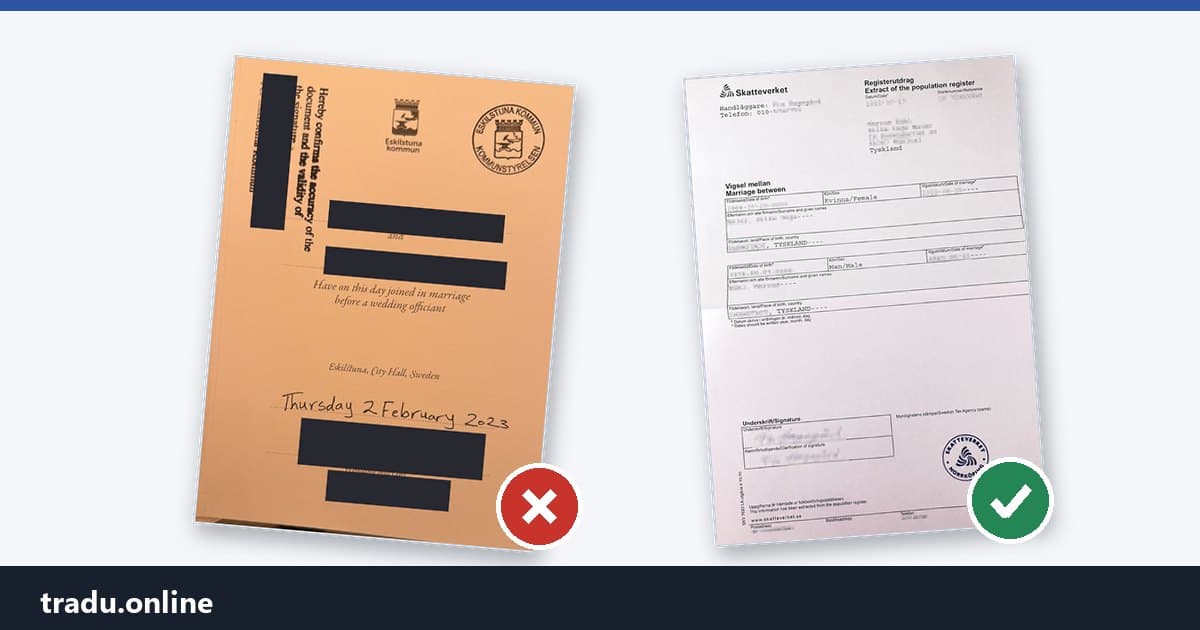
A client recently sent us two sheets of paper he had brought from Sweden: a handsome decorative certificate bearing the coat of arms of the town of Eskilstuna and the registrar's signature, and a form with the Skatteverket letterhead, partly filled in by hand. He was sure he was holding his marriage certificate.
He wasn't. The first document was a memento of the ceremony with no legal value. The second was the internal form the registrar uses to report the marriage to the tax authority — in effect a request for registration, not proof that the registration ever took place. The document he actually needed is called Registerutdrag, vigsel, form SKV 7693, bilingual Swedish-English, with the round Skatteverket stamp.
Had he gone straight to translation and an apostille, he would have paid, waited, and been turned away at the counter in Chișinău.
This is not an exceptional case. It is the pattern. Below are the traps we come across most often.
The Swedish case step by step, with photos of the rejected papers and the right one: Swedish marriage certificate — which document is accepted.
1. The keepsake mistaken for the certificate
The most common mistake of all. An elegant booklet or diploma, handed over on the very day of the event, which nobody tells you is purely symbolic.
| Country | The keepsake | The real document |
|---|---|---|
| France | livret de famille | copie intégrale de l'acte de mariage, from the town hall of the place of marriage |
| Netherlands | trouwboekje | afschrift huwelijksakte, from the gemeente |
| Germany | Stammbuch der Familie | Eheurkunde, from the Standesamt |
| Spain | Libro de Familia (no longer issued) | certificado literal de matrimonio |
| Sweden | the municipality's decorative certificate | Registerutdrag, vigsel |
2. The short extract instead of the full one
The short version costs less and is quicker to get. The trouble starts when the authority asks for the full version.
- Poland: odpis skrócony versus odpis zupełny. For a change of name or for regaining citizenship, you need the full one.
- Spain: certificado en extracto versus certificado literal. For Moldova the literal version is always required; it reproduces the text of the record together with the marginal notes.
- Italy: certificato di matrimonio, estratto per riassunto and copia integrale dell'atto. If there have been divorces or changes of name, the notes appear only in the copia integrale.
- Sweden: a personbevis issued for the purpose “Adress” instead of “Utdrag om folkbokföringsuppgifter – 120”.
The difference is not about price. It is about what the official in Moldova sees on the page.
3. The document printed at home
The Nordic countries, Estonia and the Netherlands have moved heavily to online services. You log in to your personal account, download the PDF, print it — and are surprised when the notary refuses to apostille it.
The telltale signs of such a document: a QR code where the stamp should be, wording along the lines of “end of listing”, no name of the official who issued it. For international use you need the paper copy, ordered separately, with a wet stamp and a signature.
4. The form meant for internal use
These are papers issued or received by an authority, with a letterhead and sometimes a stamp, but made for the internal use of that country's administration. They look like a certificate, yet they do not prove the marriage — and still they reach us in place of the marriage certificate:
- Germany: Meldebescheinigung — the certificate of residence from the Bürgeramt. It confirms the address you are registered at, not the marriage. The document you need is the Eheurkunde from the Standesamt.
- Italy: autocertificazione — a self-declaration in which you yourself state that you are married. In Italy it stands in for a certificate before the administration; outside Italy it has no value. The document you need is the estratto per riassunto or the copia integrale dell'atto di matrimonio.
- Finland: the certificate of examination of impediments to marriage. It is issued before the wedding and shows only that you are free to marry, not that you did. The document you need is the population register extract that records the marriage.
5. Church documents
In Denmark and Norway, population records were historically kept by the parishes, and some certificates are still issued through the parish office today. Those are valid. Certificates of a religious wedding, however, are not — and neither are baptism certificates from Catholic countries.
6. Two entirely different multilingual forms
This is where most money is lost, needlessly.
CIEC Convention No. 16 (Vienna, 1976)
The Republic of Moldova acceded through Law No. 4-XVI of 7 February 2008. A multilingual extract issued under this convention is recognised without an apostille and without a translation, and is used on the same terms as a national civil status certificate.
The states parties that matter for our diaspora: Germany, France, Italy, Spain, Portugal, the Netherlands, Belgium, Luxembourg, Austria, Poland, Lithuania, Estonia, Croatia, Slovenia, Bulgaria, Romania, Serbia, Turkey, Switzerland.
Regulation (EU) 2016/1191
An entirely different logic: the multilingual standard form is only an explanatory annex attached to the national document, does not replace it, and works exclusively within the European Union. For Moldova it has no effect at all.
7. The authority that issues the apostille differs from country to country
One trip to the wrong office means a week lost:
| Country | Who issues the apostille |
|---|---|
| Sweden | Only a notarius publicus, appointed by the regional prefecture. Neither Skatteverket nor the foreign ministry. |
| Finland | The population register agency, directly. |
| Italy | The Prefettura for administrative and civil status documents, the Procura della Repubblica for judicial and notarial ones. |
| Germany | It depends on the federal state — Landgericht, Regierungspräsidium or Bezirksregierung. |
| France | Notaries — 15 centres run by the regional councils and interdepartmental chambers of notaries (since 1 May 2025), usually in electronic form. The courts of appeal no longer issue apostilles. |
| Netherlands | Any district court (rechtbank). |
| Spain | The Ministry of Justice or the high court of justice of the autonomous community. |
We have explained how the apostille works in general in our guide The Hague Apostille; for countries outside the Hague Convention, see consular legalization vs. apostille.
8. The apostille placed on the wrong copy
Sometimes the apostille ends up on a certified copy rather than on the original. For civil status documents, Moldova and Romania frequently reject this.
What we actually do
Translation is the last step, not the first. Before it, we check:
- whether the document you have really is the one required, or a keepsake, an internal form or an abridged version;
- whether the issuing country offers the multilingual extract, in which case we tell you plainly that you do not need our translation services for that document;
- exactly where the apostille is issued in that country;
- in what order the steps have to be taken so that your file is not rejected.
Send us a photo of the document. We will tell you the same day whether it is the right one and what comes next. The check is free of charge — we would rather translate the right document for you than bill you for a useless one.